
Is chiropractic care safe for kids? Here's what parents and grandparents want to know.
The nervous system is the first system to develop in the human body. Protecting it from day one can be one of the more meaningful investments a family makes in a child's long-term health.
Most parents wouldn't think twice about taking their child to the dentist for a routine checkup, even before a single cavity shows up.
The logic is simple: catching things early keeps small stuff small.
The same logic applies to the spine and nervous system, yet chiropractic care for kids is still one of the most misunderstood tools available to families who want to support their child's health from the ground up.
Understand why the nervous system is the place to start
Before a baby's heart even develops in the womb, the nervous system is already forming. A small cluster of gray matter becomes the brain, which develops a primitive spinal cord called the notochord. From that notochord, buds branch off to form every organ in the body.
The nervous system comes first because everything else depends on it. That's not just an interesting biology fact, either. It's a pretty good guide for how to prioritize health at every stage of life.
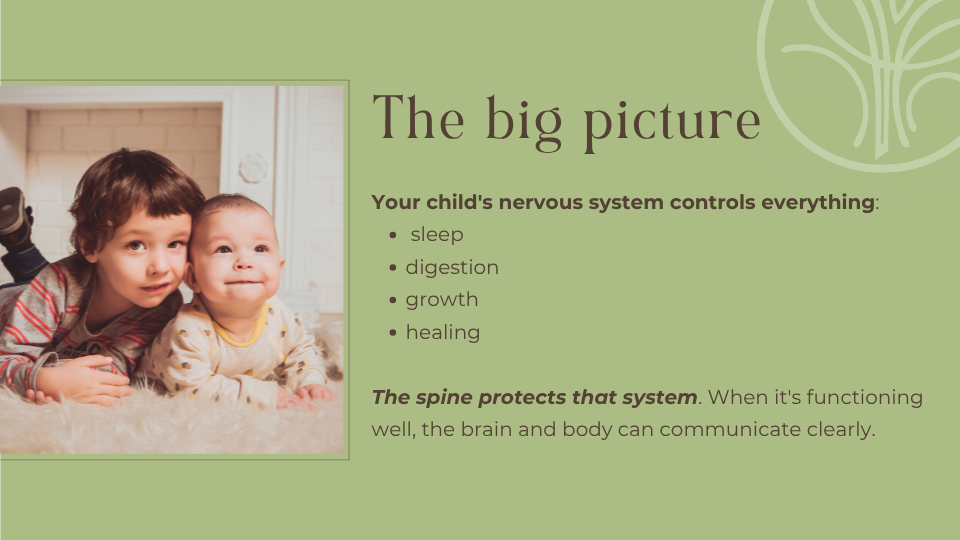
The spine houses and protects the spinal cord, and the spinal cord is the main highway the brain uses to talk to every organ and system in the body. So, the health of that spine matters from the very first days of life.
A subluxation is a misalignment in the spine that gets in the way of that communication. Think of it like weak Wi-Fi: the signal's still there, but it keeps buffering. Information gets missed, and the body ends up working with incomplete data.
In adults, that kind of interference has often been building for years. In kids, catching it early means the body hasn't had time to adapt around the problem yet, which tends to make correction quicker and simpler.
Know that chiropractic care for children is safe and well-researched
The number one reason parents hesitate is safety, and that's a completely fair question to ask.
The research on this is reassuring: chiropractic care for children has a strong safety record.
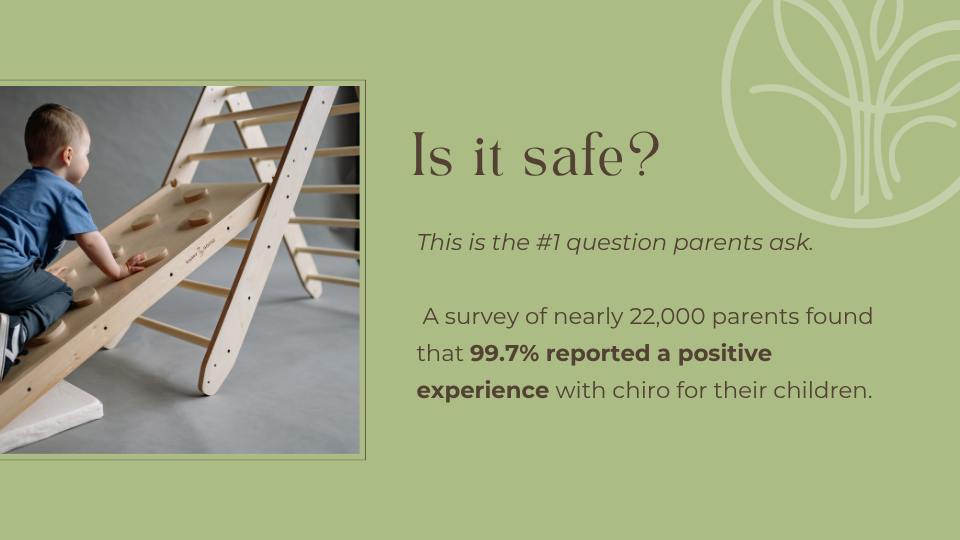
A study of nearly 22,000 parents who brought their young children in for chiropractic care found a 99.7% positive experience rate. The most commonly reported side effect was mild, temporary crankiness after an adjustment. No serious adverse events were reported.
Pediatric adjustments themselves look nothing like what most people picture.
For infants, a typical adjustment involves light fingertip pressure, often no more force than you'd use to test a tomato for ripeness. Some chiropractors use an instrument called an activator, which delivers a gentle, fast impulse that stimulates the nervous system without any forceful manipulation.
Most babies also have far fewer subluxations than adults do, typically two to four instead of ten to fifteen. Because those patterns haven't had decades to set in, they tend to correct quickly.
Start checking children earlier than you think necessary
Subluxations don't only begin at birth. They can start in the womb. Limited space to move, a mother's own spinal misalignments affecting the baby's positioning, and the birth process itself (which is physically significant for both mother and baby) can all play a role.
Because of that, we recommend having a newborn checked as soon as possible after birth. The earlier a subluxation is identified, the less opportunity it has to affect development down the line.
For infants, a few common signs worth paying attention to include:
Notice if feeding seems harder on one side than the other. This can point to tension or restriction affecting the muscles and nerves involved in feeding.
Watch for colic or general crankiness that doesn't seem to have an obvious cause.
Pay attention to a poor startle reflex, since this reflex is a good early marker of nervous system function.
Check whether your baby rolls to both sides equally. A strong preference for one side can be a clue worth investigating.
See whether your baby brings both feet to their mouth. Uneven movement here is another pattern worth a second look.
As a general baseline, getting kids checked every three months through the first year accounts for how fast development happens during that window. As children grow, start walking, take their share of tumbles, carry backpacks, and spend more time hunched over screens, regular checkups continue to support healthy development along the way.
Recognize the conditions where chiropractic care has shown real results in children
Many families first come in because of a specific concern, often after other approaches haven't moved the needle. Some of the most common reasons parents bring kids in include colic, bedwetting, sleep trouble, and headaches.
Colic is one of the more well-documented areas of pediatric chiropractic research. A clinical trial conducted in Denmark compared standard anti-gas medication with chiropractic adjustments for colicky babies, and the adjustments came out ahead. That tracks physiologically: the nerves that regulate digestion run through the same spinal segments that are commonly misaligned in infants. When those segments are adjusted, and nervous system communication improves, digestion tends to settle down, and often so does the baby.
Bedwetting is another area where chiropractic care has shown promising results. Bladder control during sleep is a neurological function, and the brain has to maintain subconscious control over the bladder through the night. When there's a miscommunication in the nervous system, particularly through the sacral segments of the lower spine, that control can break down. That's not a behavior problem or a character flaw in the child; it's a communication issue. A clinical trial found that more than 50% of children receiving chiropractic care for bladder control issues saw a reduction in wet nights, and one in four children saw more than a 50% improvement.
Sleep can also be affected, since melatonin regulation is influenced by chiropractic adjustments. That's part of why some kids who get regular care also notice better sleep quality. For young athletes, better nervous system function tends to show up as better movement, coordination, and recovery, too.
Address posture and spinal development before problems become permanent
As the twig is bent, so grows the tree. It's an old saying, but it holds up here.
The spinal patterns that develop during childhood become the foundation for the spine that carries a person through adulthood, and addressing those patterns early, while the spine is still growing and adaptable, tends to work better than trying to untangle them later.
Many kids who present with what looks like early scoliosis are actually experiencing a spinal shift, which is meaningfully different from true structural scoliosis, and these children often respond well to adjustments and targeted exercises. For kids with confirmed scoliosis, early chiropractic care can't guarantee the curve won't progress, but it may help support better function and, in some cases, reduce how much more intensive intervention is needed down the road.
Screens are creating a new generation of postural concerns that simply weren't as common ten years ago. Nearly every teenager who comes in for a spinal X-ray now shows their head sitting noticeably forward of their shoulders, in some cases more than an inch forward in a 17-year-old. That kind of postural shift adds real effective weight to what the spine is carrying. It tightens the muscles of the chest and upper back, can affect breathing, and has even been linked to lower confidence and mood.
Backpacks are another easy-to-overlook factor. A child's backpack shouldn't exceed 10 to 15% of their body weight, which for smaller kids is a surprisingly small number. Most school bags go well over it.
Tips for students to maintain healthy posture:
Use a locker when it's available so kids aren't hauling every book all day.
Distribute weight evenly across the bag rather than piling everything into one pocket.
Wear both shoulder straps instead of slinging the bag over one shoulder, since one-strap carrying pulls the spine out of alignment over time.
Support your child's spine health with daily habits at home
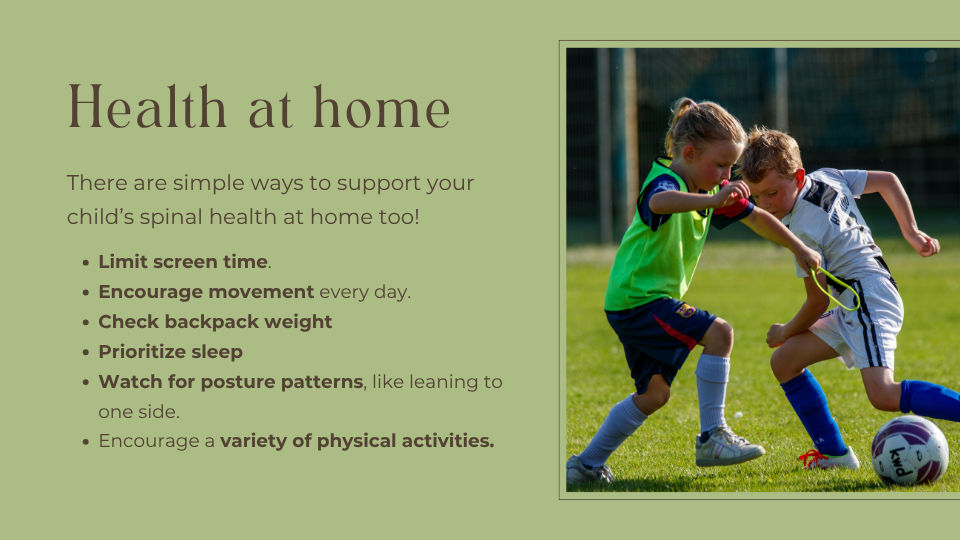
Chiropractic care works best alongside healthy daily habits at home. A few simple practices can make a real difference in how well a child's spine and nervous system develop.
Prioritize outdoor play over screen time. The nervous system learns through movement, and outdoor play offers a full mix of visual, auditory, and physical input that screens simply can't match. Screens, by contrast, overstimulate the visual centers of the brain while leaving the movement and coordination centers understimulated, an imbalance that's been connected to challenges with attention and coordination.
Protect your child's sleep. During sleep, the spine decompresses, the nervous system consolidates learning, and the body repairs itself, so keeping an eye on sleep posture and support matters just as much as bedtime itself.
Watch for visible postural signals. A high shoulder in family photos, a head that's always tilted the same way, uneven hips, or a tendency to lean on one side when standing or sitting are all worth mentioning at your next visit. These patterns are easy to miss because they build up gradually, but they're meaningful clues that the spine could use some support.
Bringing a child in for a checkup doesn't require a specific complaint or a crisis moment. The screening process is simple and noninvasive. If subluxations show up, a gentle, age-appropriate care plan can be put together. If they don't, you walk away with peace of mind either way. Either way, you are investing in the foundation of your child's health at exactly the time when that investment has the greatest possible return.
If your child has not been checked recently, or if you know a family who has questions about pediatric chiropractic care, we encourage you to reach out and get them on the calendar. And if your own next appointment is not yet scheduled, now is a great time to take care of that too. We are here for your whole family, at every age and every stage.