
What chiropractic actually treats, where it came from, and who it's really for
How much do you actually know about chiropractic care? Not just that it helps with back pain, or that you feel better after an adjustment, but the real story behind where it came from, how it works, and why it matters for your whole body, not just your spine.
This year, we swapped one of our regular workshops for a trivia night, and the questions we asked revealed something interesting: even our longtime patients were surprised by a few of the answers.
So here's a closer look at what we asked, what we learned, and why each answer matters for your care.
Where did chiropractic care actually come from?
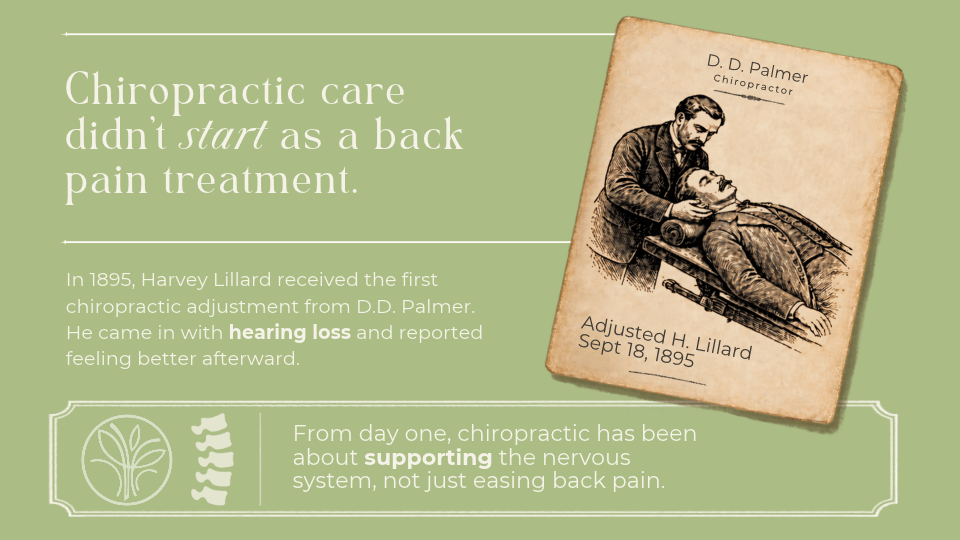
The first recorded chiropractic patient was a man named Harvey Lillard, and he came in with hearing loss. After receiving the first-ever chiropractic adjustment from D.D. Palmer in 1895, Lillard reported that his hearing improved.
That story is more legend than clinical trial, and we're not here to promise the same result for you. But it points to something true about chiropractic's original premise: it was never designed as a back pain treatment. It was designed as a nervous system approach.
D.D. Palmer built his entire philosophy on one idea: the body has an inborn ability to function well when the spine is aligned, and the nervous system isn't under stress. That idea is still the foundation of chiropractic care today.
What is a subluxation, really?
The word "subluxation" gets tossed around a lot at the chiropractor's office, but if you've never had it explained plainly, you're not alone. In simple terms, a subluxation is a vertebra that's shifted out of its ideal position, putting stress on the surrounding nerves and slowing down communication between your brain and your body.
You know how a pebble in your shoe is annoying at first, and then somehow you stop noticing it? You don't stop to shake it out. You just start walking a little differently to work around it. A subluxation can work the same way. Your body quietly compensates, and you might not realize anything's off until the workaround starts causing problems of its own.
Here's the part that surprises people most: subluxations don't always come with pain. Your spine can be out of alignment for months or years before you notice anything's wrong. That's one reason regular checkups matter, even when you feel fine.
Can subluxations start at birth?
This trivia question tripped up a lot of people. The options were: your first day of school, birth, learning to walk, and your wedding day. The answer is birth.
Even a smooth delivery puts real physical force on a baby's neck and spine. Add in forceps, vacuum assistance, or a tight squeeze through the birth canal, and that force goes up considerably. None of that is anyone's fault. It's just the nature of how babies enter the world.
That's the reasoning behind checking newborns and infants early. A body that starts out well-aligned tends to have an easier time adapting as it grows, which is why so many families bring their little ones in for a first checkup within the first weeks of life.
What body system does chiropractic actually work with?
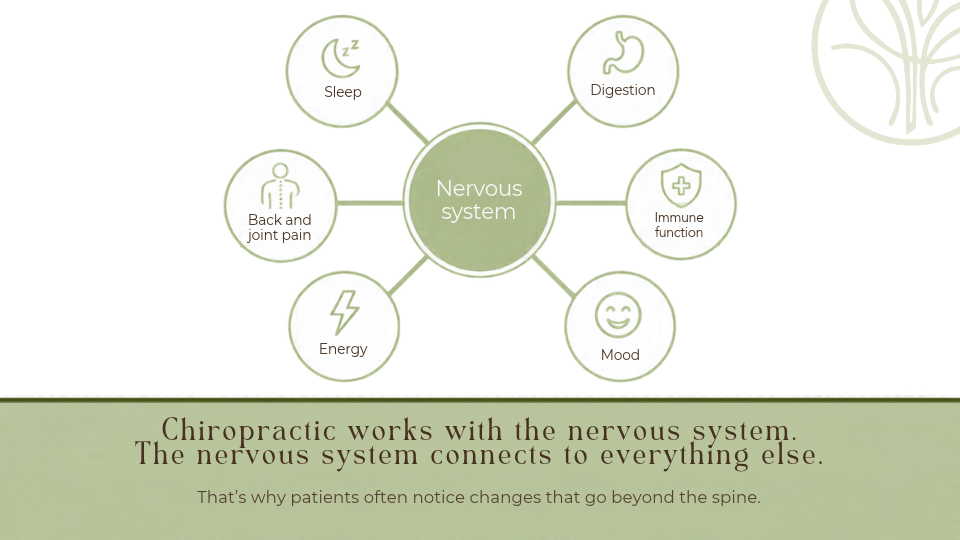
Chiropractic isn't a digestive treatment, a circulatory treatment, or an immune treatment, though it can support all of those in the process. What it directly works with is your nervous system.
Your nervous system is the body's master control center. It's the reason your brain and body can talk to each other at all, sending signals through your spinal cord and out into every organ and tissue. When your spine is aligned, those signals travel clearly. When it isn't, some of that communication gets interrupted.
That's the real reason chiropractic patients often notice changes beyond just their back. It's not that we're treating sleep issues or digestion directly. It's that a nervous system with less interference tends to help every system it's connected to run a little smoother.
Who can actually benefit from chiropractic care?
Our final trivia question asked who chiropractors can treat: adults, children, animals, or all of the above. The answer is all of the above.
Any creature with a spine can be adjusted, and chiropractic care is used with horses, dogs, and other animals for the same reasons it's used with people. On the human side, we see patients ranging from newborns to seniors, and from pregnant women to competitive athletes.
Speaking of athletes, every NFL team keeps a chiropractor on staff, right alongside their athletic trainers. That's not a perk. It's part of how professional teams manage recovery and performance, because a nervous system working at full capacity supports better movement and faster recovery. The same principle holds true whether you're training for a marathon or just trying to keep up with your grandkids.
How much of our healthcare spending goes toward prevention?
Here's a number worth sitting with. The United States spends roughly $7 trillion on healthcare every year. Of that, only about 3% goes toward chiropractic care.
Sit with that gap for a second. Most of that spending goes toward treating conditions after they've already developed, managing symptoms, and covering the long-term costs of chronic disease. A small slice goes toward proactive, prevention-focused care.
That gap says a lot about how our healthcare system is built: mostly to react, rather than to prevent. Chiropractic care leans the other direction. It's about supporting your body's own systems before small issues become bigger ones, rather than waiting until you're out of options.
Is chiropractic the oldest form of natural healthcare?
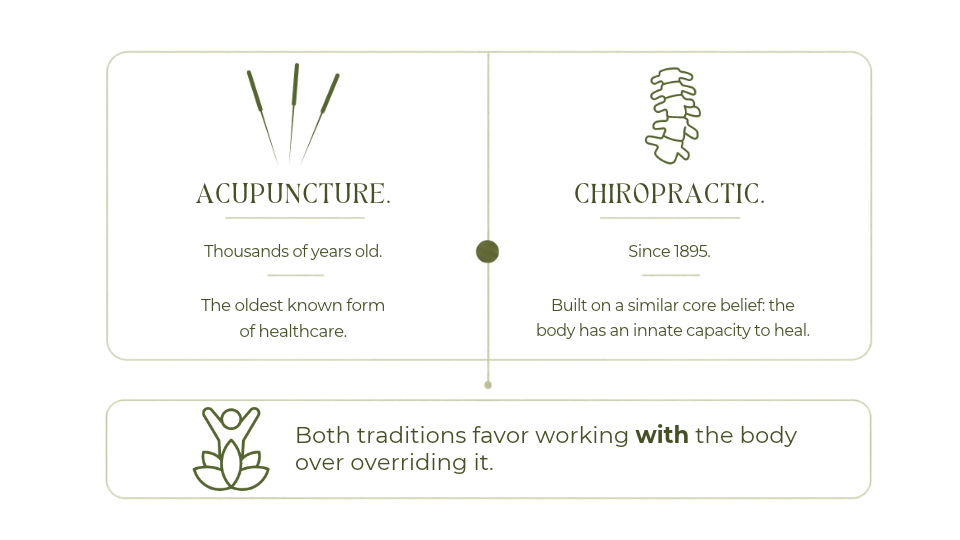
One of the trickier questions of the night asked about the oldest known form of healthcare in the world. A lot of people guessed chiropractic. The real answer is acupuncture, which has been around for thousands of years.
This one matters because it places chiropractic inside a much longer tradition, one built on the idea that the body has an innate capacity to heal when it's properly supported. Chiropractic has only been around since 1895, but it shares that same core belief with practices going back millennia: work with the body's natural systems instead of overriding them, and you tend to get results that last.
Why we use the tree of life as our symbol
Our logo is a tree of life: deep roots, a strong trunk, and branches that keep reaching upward. That image isn't just decoration.
It reflects what we care about most: whole-person care, for every age and stage, with a focus on prevention rather than reaction. Just like a tree can't thrive with compromised roots, your body has a harder time thriving when your nervous system is under stress it doesn't need.
Every adjustment is aimed at the same goal: clearing that interference so your body has the best possible conditions to do what it already knows how to do.
Chiropractic care goes well beyond back pain relief. It's a long-studied, broadly applicable approach to supporting your nervous system at every stage of life, whether you're a newborn, a weekend walker, or a competitive athlete.
Consistency is the part that actually moves the needle
Here's the thing about all this trivia: it's fun to learn, but it doesn't do much for your spine sitting in your head. The value shows up when adjustments happen regularly, not just when something starts to hurt.
Remember that pebble in your shoe? Shaking it out feels great, but nobody expects to go the rest of their life without picking up another one. Your spine is the same way. It takes daily hits (sitting at a desk, sleeping wrong, chasing kids around, training for that next race), so the checkups need to keep happening, too.
If you've been meaning to get back in, or you're due for your next visit, you can schedule your appointment here.