
Insights from: How Safe Are Adjustments
Is chiropractic care actually safe? Here's what the research says.
Chiropractic adjustments are one of the more researched, lower-risk options for supporting your body's ability to move and function well.
If you've ever hesitated to book an adjustment because you weren't sure about the safety, you're not alone. Social media clips of dramatic "cracks" don't help. Neither does years of hearing that medication or surgery is the only "proven" path to feeling better.
But when you look at the actual research, chiropractic care holds up well. In many cases, it's a lower-risk option than the over-the-counter pain relievers already sitting in your medicine cabinet.
Understand why your body already knows how to move well
Your body is built to move, adapt, and function well on its own. It's constantly working to keep you moving and feeling good.
That process can get interrupted when your spine isn't aligned the way it should be. That's where adjustments come in.
They're not about "cracking" anything. An adjustment is about restoring movement in a restricted joint and supporting healthy nerve flow, so your nervous system can do its job more efficiently.
Know what that popping sound really means
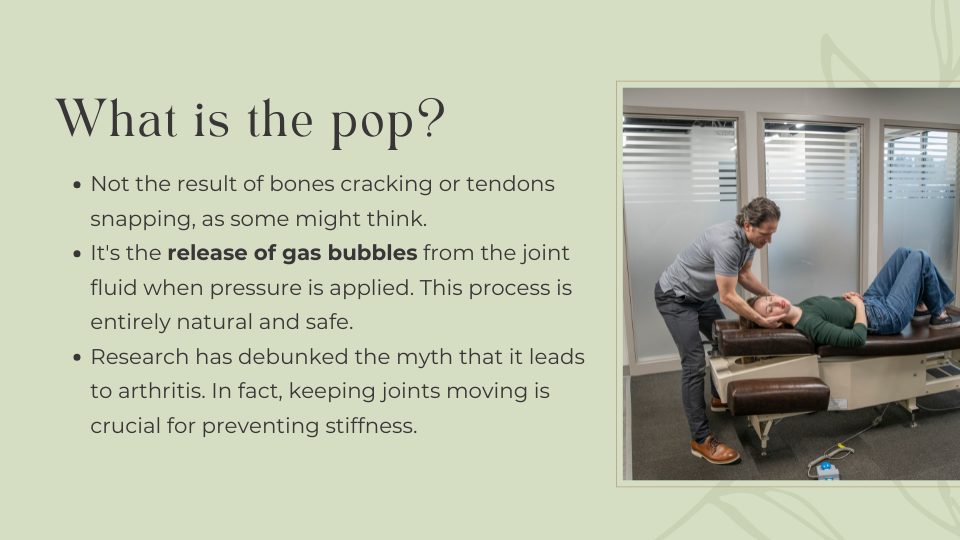
Let's clear up the biggest myth first: that pop isn't your bones cracking. It's a release of nitrogen gas from the fluid inside your joints, the same thing that happens when you crack your knuckles.
Here's the mechanism: when a joint gets restricted, pressure builds up inside the joint capsule. A quick, gentle adjustment releases that pressure, and the "pop" is simply the sound of gas escaping.
You also don't need to hear a pop for an adjustment to work. Techniques like drop-table pieces use gravity and gentle, controlled force instead. They can be just as effective at restoring motion, even without any noise at all.
Compare the real risks: adjustments vs. everyday medications
This is where the research gets interesting. Serious complications from chiropractic care are extremely rare, statistically comparable to the odds of being struck by lightning.
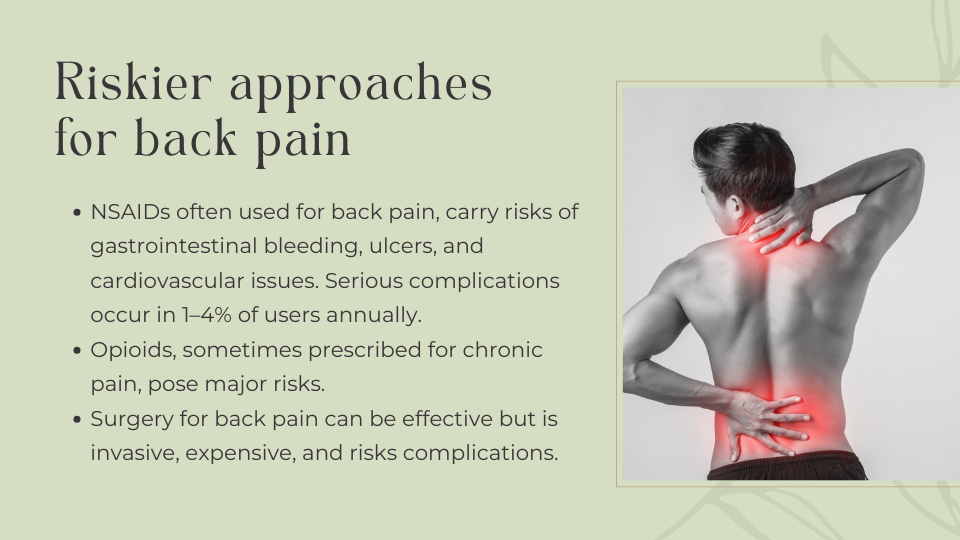
Compare that to common over-the-counter pain relievers like aspirin and ibuprofen. Used regularly, they carry real risks, including gastrointestinal bleeding, ulcers, and cardiovascular issues, and these complications show up in a notable percentage of regular users every year.
Opioids carry steeper risks still, particularly around long-term dependency. Surgery, while sometimes necessary, tends to come with higher costs, longer recovery times, and more potential for complications than a gentle adjustment.
Put another way: you're statistically more likely to be involved in an incident on the drive to your appointment than to experience a serious adverse event from the adjustment itself.
Look at the research: chiropractic care and fewer hospital stays
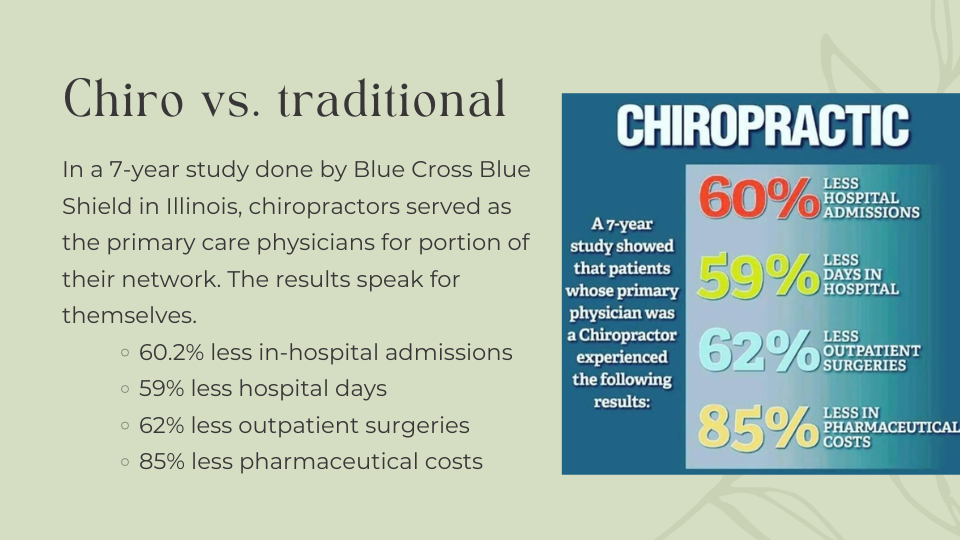
This isn't just a feel-good claim. A seven-year study conducted by Blue Cross Blue Shield of Illinois looked at what happened when chiropractors served as primary care providers for a portion of their network.
The results were notable. Patients who saw a chiropractor first had roughly 60% fewer hospital admissions and close to 60% fewer hospital days compared to patients who didn't.
Medicare data tells a similar story. When Medicare patients accessed chiropractic care, it corresponded with a reduction of roughly a third of a million primary care physician visits, saving an estimated $83 million. Patients in that data also reported better activities of daily living and improved self-rated health.
The takeaway: consistent chiropractic care is associated with fewer hospitalizations and real, measurable savings, both in dollars and in wear and tear on your body.
Expect a little soreness, and know why it's normal
It's common to feel a bit sore after an adjustment, especially early in your care. Research suggests about 20% to 50% of people experience some soreness initially, and there's a good explanation for it.
Think of it like this: when your body has been compensating with the "wrong" muscles for a while, an adjustment asks different, often underused muscles to start doing their job again. It's a lot like the soreness you feel after a workout you haven't done in months. Your body is relearning a healthy movement pattern, not signaling that something went wrong.
This soreness typically fades within 24 to 48 hours. That's part of why consistent, regularly scheduled care matters. It gives your body the chance to fully adapt instead of bouncing between "hurting" and "fixed."
Skip the self-adjustment, even if you're tempted
We get it. Once you've felt how good a proper adjustment feels, it's tempting to try to replicate it yourself.
Here's the catch: even chiropractors can't effectively adjust themselves. Twisting or stretching to get a pop might release tension in areas that are already fairly mobile, but it won't address the joints that are truly restricted.
Repeatedly forcing movement in the same spots can also lead to hypermobility, where a joint becomes too mobile instead of too stiff. That can create more pain and instability over time, not less.
Think of a restricted joint like a rusty hinge. Yanking on the door harder doesn't fix the hinge. It just wears down the parts that already move fine. Leave the precise, targeted work to your chiropractor. It's not just about knowing where to move; it's about controlling the exact angle and speed needed to move that joint safely.
Support your adjustments with simple daily habits
The care you get in the office works even better when it's paired with small daily habits at home.
Move every day. A short walk, even in the cold, helps keep your spine and joints mobile between visits.
Manage your stress. A few minutes of deep breathing or quiet meditation can ease the tension that tends to build up in your ligaments and joints.
Stay hydrated. Your body is roughly 70% water, so this one habit supports nearly everything else, including your joints and spinal discs.
Use gentle home tools. A foam roller or at-home rehab tool can help you maintain the mobility you built during your visit.
Eat with your joints in mind. A steady, balanced diet supports your joints and ligaments from the inside out.
Keep the momentum going
Feeling better isn't the same as functioning better, which is exactly why consistency matters. Skipping appointments once the pain subsides can mean losing progress your body worked hard to build.
Whether you're managing an ongoing issue or investing in long-term wellness, staying on schedule gives your body the best chance to keep making progress rather than cycling between flare-ups and short-term relief.
If it's been a while since your last visit, now's a good time to get back on the schedule. And if you already have one coming up, keep it.