
Key Insights from Move Well: How to Improve Your Posture
How to fix bad posture, reduce neck pain, and sit better every day
Before we can improve something, we need to know what we're aiming for. When you're standing, your ear should line up over your shoulder, your shoulder over your hip, and your hip over your ankle. One straight line from the ground up.
From the front, that line runs right up the middle through your ankles, pubic bone, sternum, and nose. Most of us aren't anywhere close to that ideal, and that's okay. Awareness is always the first step.
Your spine also has three natural curves that help absorb shock and keep you moving efficiently. When those curves are where they're supposed to be, your whole body works better. When they're not, that's when things start to break down.
Poor posture is more than a cosmetic problem
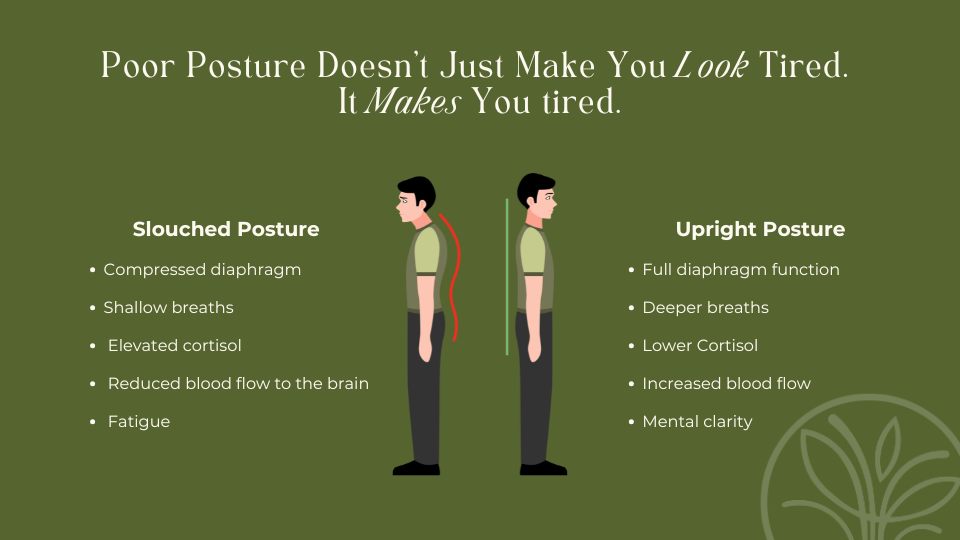
Here's something worth sitting with (pun intended): poor posture doesn't just make you look tired. It actually makes you tired.
Try this. Slouch in your chair and take a deep breath. Now sit up tall and take the same breath. Notice the difference? That's your diaphragm at work, or not at work. When you're hunched over all day, your diaphragm gets compressed, which means shallower breaths, less oxygen, and your heart and lungs working overtime just to keep up.
Beyond breathing, poor posture affects your balance, coordination, digestion, and even your brain. Research published in Health Psychology found that upright posture is associated with lower cortisol levels, increased positive mood, and higher self-esteem compared to slouched posture. When you straighten up, you're not just looking more confident. You're actually thinking more clearly.
How your head position quietly works against you
Think of your head like a bowling ball. It weighs about 10 to 12 pounds. When it's balanced directly over your spine, that weight is manageable. But when it creeps forward (as it does for most of us staring at screens), the strain on your neck and upper back multiplies fast.
Research in Surgical Technology International found that for every inch the head shifts forward, the effective load on the cervical spine can increase significantly, putting extra stress on the discs, muscles, and joints that support it.
It gets more complicated, too. Many people don't just have forward-head posture. It's also shifted off to one side, creating uneven stress on muscles and joints. Think of it like driving a car with the tires out of alignment. You can keep going, but the wear and tear catches up faster than it should.
This is one of the key reasons chiropractic adjustments matter so much here. When your spine gets back into better alignment, your body doesn't have to burn energy just keeping you upright. That freed-up energy gets redirected toward healing and proper function, which is exactly where it belongs.
How to set up your workspace so it actually supports you
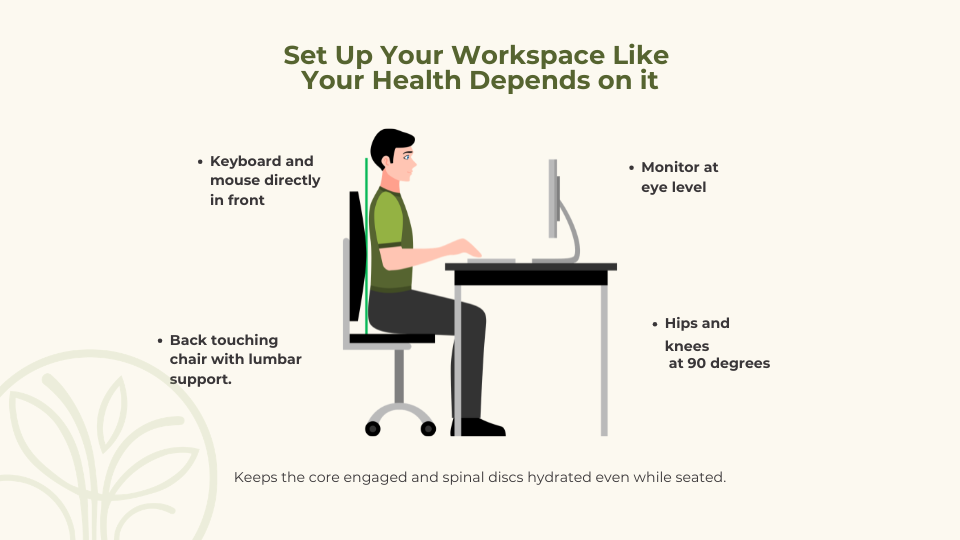
Most of us spend a huge chunk of our day sitting, so your workstation setup genuinely matters. A few things to check:
Keep your knees and hips at roughly 90 degrees. This position reduces compressive load on your lumbar discs and helps maintain your spine's natural curve rather than flattening it.
Position your keyboard and mouse directly in front of you. Reaching forward or to the side repeatedly strains the shoulder and upper back muscles over time.
Set your monitor at eye level. Even a slight downward tilt of the head for hours at a stretch adds up to significant strain on the cervical spine.
Make sure your back is actually touching the back of your chair with support for your lumbar curve. If your chair doesn't offer that, a small rolled towel or lumbar cushion works well.
One tool we highly recommend is a posture disc, the kind you sit on at your desk. Because it's slightly unstable, it keeps your core engaged even while you're seated, and the gentle movement helps keep the discs in your spine hydrated. If you're going to be sitting, this is one of the better options for desk work.
☞ Ask us about a Home Rehab Kit at your next appointment. (Spoiler alert: It comes with a posture disc!)
Why movement breaks matter more than you think
Your body wasn't built to stay still for hours. Every 30 to 60 minutes, get up and move. For every hour of sitting, aim for at least a minute or two of extension or traction, like opening up your chest and shoulders in the opposite direction of your desk slouch, lying back over a fulcrum, or gently hanging your head off the edge of a bed.
Research supports this. A study in the American Journal of Epidemiology found that prolonged sitting is independently associated with poor health outcomes, even in people who exercise regularly. Breaking it up matters.
If you miss a break, don't just let it go. Add that time to your next one. Think of it the same way you'd think about chiropractic care: if you miss a visit, you make it up. The same logic applies here.
How to build a daily posture practice that actually sticks
Good posture isn't something you just "have" one day. It's something you practice. A few habits that make a real difference:
Stretch your chest in a doorway daily. The muscles in the front of your body get chronically tight from all the forward-leaning we do. Releasing them regularly helps counteract that pattern before it becomes a problem.
Strengthen your mid-back by lying face down and pumping your arms back. This counters the weakness that builds up when those same muscles are stretched and underused all day long.
Work your core with planks, bridges, and bird dogs. Your core is the foundation of good posture, and research in the Journal of Physical Therapy Science has linked core strength directly to improved postural stability and spinal control.
Add balance training. It trains the receptors in your feet, builds core strength, and improves overall alignment in a way that traditional strength work often misses.
Do posture scans throughout your day. Pause, check in: is your head forward? Are your hips shifted? Make a small adjustment and move on. It takes about two seconds and adds up to a big difference over time.
☞ Take a look at our Posture Habits Guidefor more ideas!
Why chiropractic care ties all of this together
Everything here works best when it's paired with consistent chiropractic care. Adjustments help retrain your spine, support your nervous system, and make all of these other habits more effective. Think of your adjustments as the anchor for everything else you're doing.
If you have questions about your posture or want a personalized plan, bring them to your next appointment. That's exactly what we're here for.