
Why do I feel foggy, tired, or wound up for no reason? It might be how you're breathing.
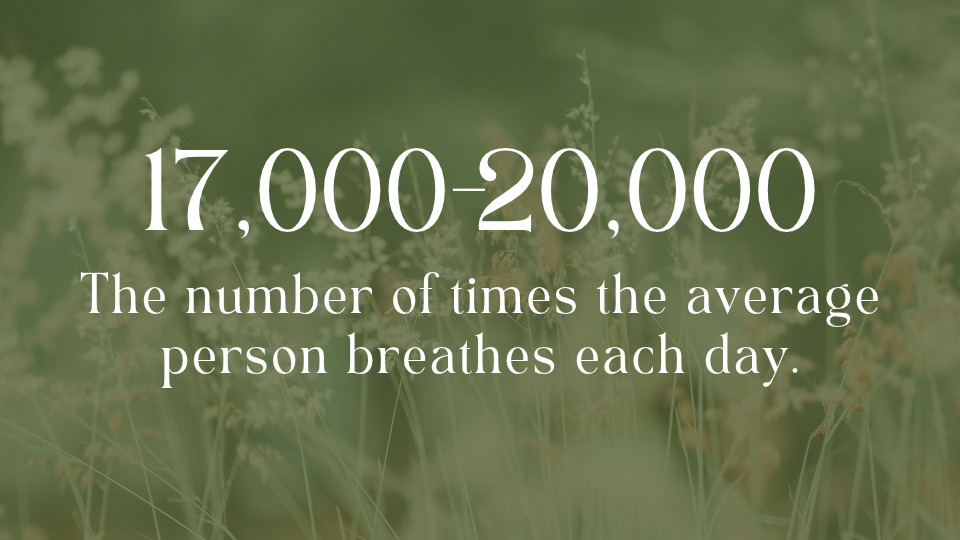
Most people go their entire lives without thinking about how they breathe. It happens automatically, thousands of times a day, without any conscious effort.
But the quality of those breaths, whether they're deep or shallow, nasal or mouth, relaxed or restricted, has a real and measurable impact on brain function, stress levels, energy, healing, and the health of your nervous system as a whole. It's one of the most accessible tools you have for feeling better and thinking more clearly. And it costs nothing.
What your brainstem is doing every time you take a breath
Breathing is controlled by your brainstem, the oldest and most primitive part of the brain. Unlike the higher brain centers that handle conscious thought and decision-making, the brainstem works like a built-in pacemaker, keeping your breathing rhythm going whether you're awake, asleep, or unconscious.
This is why people with a severe spinal cord injury near the neck sometimes need a ventilator. The injury disrupts the brainstem's ability to send the signals that keep breathing happening on its own.
That pacemaker runs continuously by itself, but it can be influenced by higher brain centers through conscious effort. This is the whole premise behind breathwork: you can intentionally override an automatic process and shift your entire physiology in the process.
Think of your nervous system as a dashboard full of dials you can't normally reach: heart rate, digestion, hormone release. Breathing is the one dial you're allowed to turn by hand.
Your breathing rhythm also responds to your emotional state. Get stressed, and your breath changes. Calm down, and it changes again. The relationship runs both ways, too. Just as your emotions shape your breathing, deliberately changing how you breathe can shift your emotional and physiological state right back.
Why oxygen matters so much for your energy and healing
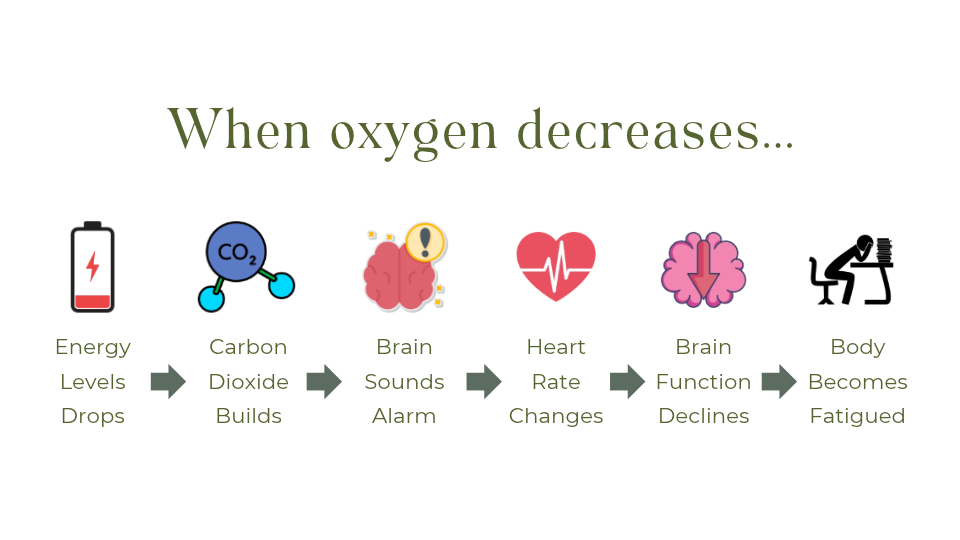
Oxygen is essentially cellular fuel. Every cell in your body uses it to produce ATP, the energy source that powers everything you do. When your breathing is shallow or restricted, less oxygen circulates through your body, and your cells have to work harder to stay energized.
Over time, that added effort adds up to fatigue, brain fog, tension, and slower healing.
Iron plays a role here too. It's the mineral that lets red blood cells bind and carry oxygen to your tissues. Iron deficiency is one of the most common nutritional gaps out there, and even a mild deficiency can meaningfully reduce how efficiently your body delivers oxygen. It's one reason nutrition and breathing can't really be separated in a whole-body approach to health.
How you breathe matters just as much as how deeply. Researchers in Sweden found that healthy adults absorbed roughly 10% more oxygen into their blood when breathing through the nose instead of the mouth, largely thanks to the nitric oxide your nasal passages release with every inhale.
Chiropractic adjustments support this process directly by improving how freely your rib cage moves. When your thoracic spine and ribs move well, your lungs can expand more fully with each breath. More expansion means more oxygen for the same amount of effort, which is one reason many patients notice a real lift in energy after regular adjustments.
The 5 types of breathing (and what each one tells you)
Not all breathing is created equal. Knowing the difference helps you recognize what your body is doing and what it might need.
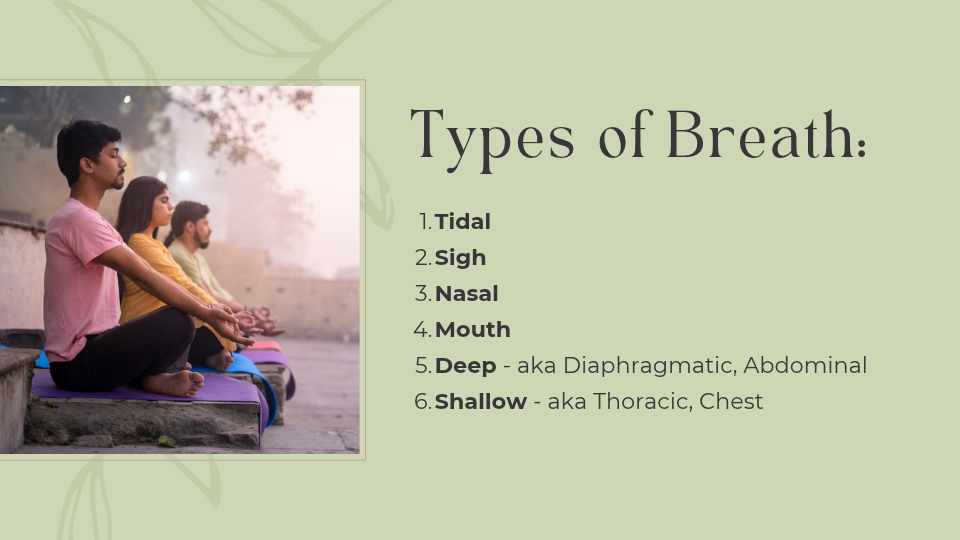
Tidal breathing is your natural resting pattern, the gentle, even inhale and exhale that happens when you're neither stressed nor exercising. It moves a relatively small amount of air and serves as your baseline.
Diaphragmatic breathing, also called belly breathing, is the deepest and most therapeutic form of breath. It means actively lowering the diaphragm so your belly expands before your chest rises. Most people have to relearn this pattern, since chronic stress and sedentary habits train the body into shallow, chest-dominant breathing instead. Diaphragmatic breathing activates your parasympathetic nervous system, the "rest and digest" state where healing, digestion, hormone balance, and recovery actually happen.
A sigh is a reflex breath your body uses to clear excess carbon dioxide when it's been building up. It inflates the small air sacs in your lungs, called alveoli, that don't get fully engaged during shallow breathing. Sighing is your body's built-in reset button, and deliberately taking a few deeper exhales has a similar effect.
Shallow, or thoracic, breathing is the default pattern for most people under stress. It relies on the accessory muscles in your neck and shoulders to lift the rib cage instead of drawing air down into the lower lungs. It's less efficient, delivers less oxygen, and contributes to tension in the neck and upper back.
Nasal breathing is meaningfully different from mouth breathing, and it's the better option in nearly every context outside of intense exercise. The nose filters, warms, and humidifies air before it reaches the lungs, and it stimulates the production of nitric oxide, a compound that dilates blood vessels and improves oxygen delivery throughout the body. Chronic mouth breathing, whether from habit or congestion, is associated with poorer sleep and higher stress levels.
What shallow breathing is actually doing to your brain
Some researchers estimate that as many as 70 to 80% of people default to shallow breathing throughout the day. That's not a minor issue. It touches nearly every system in the body.
When you're not getting enough oxygen, your brain reads it as a low-grade threat. Cortisol stays elevated. Your nervous system lingers in a mild fight-or-flight state. Blood pressure tends to run higher. Mental clarity suffers, healing slows, sleep quality drops, and energy gets spent faster than it's replenished.
The connection between shallow breathing and stress creates a loop: stress causes shallow breathing, and shallow breathing signals more stress right back to your brain. That loop tends to continue until something interrupts it. Deliberate breathwork is one of the more direct ways to break the cycle, because it works at the level of your nervous system rather than just addressing the downstream symptoms.
If you frequently feel tired, foggy, anxious, or wound up without an obvious cause, your breathing pattern is worth a closer look.
How to practice diaphragmatic breathing (and use more of your lung capacity)
Most people use only 60 to 70% of their lung capacity day to day. A 2017 study published in Frontiers in Psychologyfound that after eight weeks of diaphragmatic breathing training, participants showed significantly lower cortisol levels and better sustained attention compared to a control group.
Here's a simple way to learn diaphragmatic breathing:
Lie on your back and place a book or a light weight on your belly, just above the navel.
Breathe in slowly, and let the book rise before your chest does.
If only your chest moves, you're breathing thoracically rather than diaphragmatically. That's normal at first.
Keep practicing until your belly leads the way every time.
Training your belly to move first re-engages the diaphragm and starts to rewire the pattern over time. Give it a few weeks of daily practice before you judge whether it's working.
Box breathing is one of the most practical techniques for everyday use, and you can do it anywhere in just a few minutes:
Inhale for a count of five.
Hold for a count of five.
Exhale for a count of five.
Hold for a count of five.
This pattern engages the parasympathetic nervous system, and research has linked it to lower cortisol and improved heart rate variability. It requires no equipment, no special setting, and no cost, just a minute of your attention.
More advanced breathwork practices, like the Wim Hof method, combine extended cycles of deep breathing with breath holds to produce a stronger physiological response. A 2014 study published in the Proceedings of the National Academy of Sciences found that people trained in this method could voluntarily influence their immune response, producing more anti-inflammatory markers when exposed to a bacterial toxin than an untrained control group. It's the same underlying biology that allows trained freedivers to hold their breath for several minutes: deliberate control over a system most people never consciously engage.
Make breathwork a daily practice, not a last resort
Dr. Andrew Weil, one of the most respected voices in integrative medicine, has said that if he could offer only one piece of health advice, it would be to breathe correctly. That single statement, from someone with access to every form of natural and integrative therapy available, says something important about where breath sits in the hierarchy of health practices.
Breathwork does not require an appointment. It does not require a supplement or a device. It requires only attention and intention. A few minutes of deliberate diaphragmatic breathing in the morning, a box breath before a stressful meeting, a slow nasal exhale before bed: these practices accumulate. They change the resting tone of the nervous system over time, reduce the baseline cortisol load the body carries, and improve the quality of every other health practice you engage in alongside them.
Regular chiropractic care supports all of this by ensuring the rib cage, thoracic spine, and nervous system are free to do what they are designed to do. A spine that moves well breathes better. A nervous system that communicates clearly regulates more efficiently. Every adjustment creates more capacity, and breathwork helps you use that capacity to its fullest.
If your next appointment is not already on the calendar, now is a great time to schedule it. We are here to support your nervous system, your breath, and your whole-body health at every visit.