
Insights from Science Simplified: How to Talk About Chiropractic Care with Others
How Do I Explain Chiropractic Care to Friends and Family? Is it Safe, and What Does it Actually Help With?
Even though more than 35 million Americans see a chiropractor each year, people still have a lot of questions about what chiropractic care actually is. Mention that you see a chiropractor, and suddenly you’re fielding everything from “Wait, what do they actually do?” to “Is that even safe?”
Knowing how to respond without overexplaining (or underselling it) can feel tricky. That’s why we’re sharing a clearer, more natural way to talk about it.
What’s actually happening during chiropractic care?
Chiropractic care centers on the relationship between your spine and your nervous system.
Your nervous system runs the show (movement, digestion, stress response, all of it). When the spine isn’t moving well, it can interfere with how clearly your brain and body communicate.
Think of it like a Wi-Fi signal. When the connection is strong, everything runs smoothly. When it’s spotty, things lag, glitch, or don’t work the way they should.
Adjustments aim to restore that connection by improving how the joints in your spine move and how your nervous system functions alongside them.
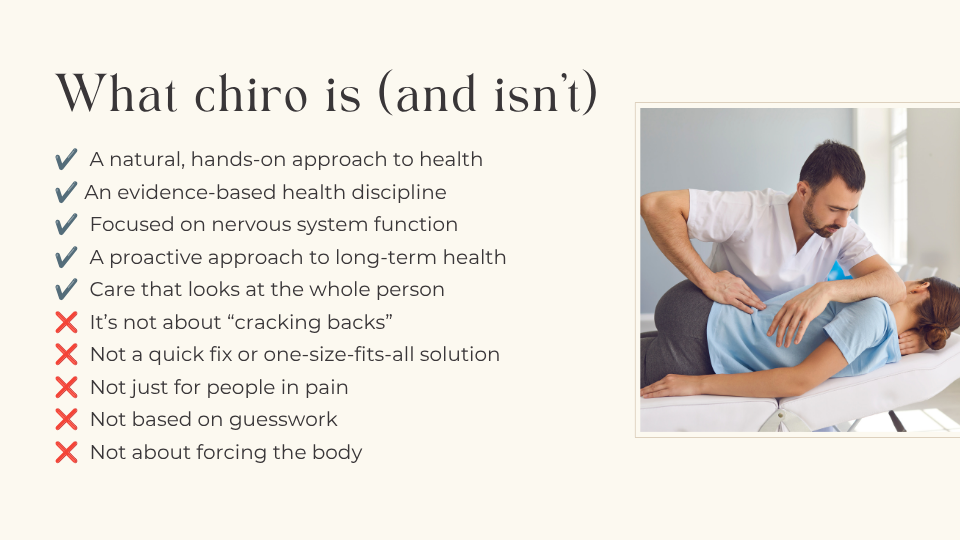
Is chiropractic care backed by science?
This is one of the most common questions people ask, especially because chiropractic care sometimes gets lumped into the category of “alternative therapies” or misunderstood as pseudoscience.
The reality is more nuanced than that.
Chiropractic care is backed by over fifty years of research and is one of the most widely studied forms of conservative musculoskeletal care, particularly for back and neck pain. Major clinical guidelines recommend spinal manipulation as a non-invasive option for certain cases of acute and chronic low back pain before moving to more aggressive interventions.
Research also shows people who seek chiropractic care for low back pain are often less likely to progress to long-term opioid use.
That doesn’t mean it’s a cure-all or an answer for every condition. It means it’s a practical, hands-on approach with a growing body of research supporting its role in helping people move better and manage certain types of pain.
What does chiropractic actually help with?
Most people think of back pain first (and yes, that’s a big reason people come in).
But that’s not the full picture.
Chiropractic care is most commonly used for musculoskeletal concerns like back pain, neck discomfort, joint dysfunction, movement quality, and physical tension.
People also often describe improvements in things like:
How your body handles stress
How efficiently you move and recover
How tension shows up in your day-to-day life
It’s less about chasing symptoms and more about improving overall function.
Is it safe?
Another fair question.
Chiropractic adjustments are considered safe when performed by a licensed provider and when care is appropriate for the person and condition being treated. They’re specific, controlled, and tailored to the individual.
Most people are surprised by how gentle they feel.
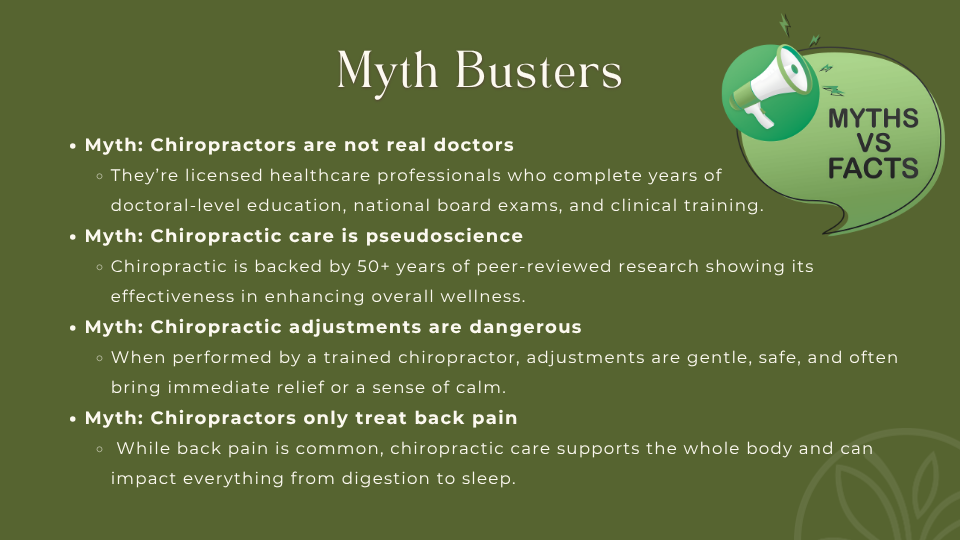
How do I explain this to someone without overcomplicating it?
You don’t need a textbook explanation. Simple, relatable comparisons go a long way.
Use everyday analogies. Compare the nervous system to Wi-Fi, a dimmer switch, or a traffic system. It helps people “see” what’s happening without needing a science background.
Keep it about function, not hype. Talk about how your body feels or moves differently, not what it “fixes.” That keeps the conversation grounded and real.
Share your experience. What changed for you? Was it better movement, less tension, improved consistency in how you feel day to day? Specifics make it relatable.
What if someone is skeptical?
That’s normal.
Instead of trying to convince them, focus on clarity:
Answer questions, don’t argue. If someone’s curious, meet them there. If they’re not, that’s okay too.
Stick to what you know. Your experience matters. You don’t need to over-explain or overstate anything.
Let curiosity do the work. Sometimes a simple, “It’s helped me move and feel better,” is enough to open the door.
Chiropractic care doesn’t have to be mysterious or complicated to talk about.
Keep it simple. Keep it honest. And make it something people can actually relate to.
If it’s been a little while since your last visit, this is a good reminder to stay consistent with what’s been working.